Long phone menus frustrate customers. AI conversational IVR allows them to speak naturally and get fast solutions. Using an AI virtual agent, teams can improve efficiency while enhancing customer support with AI at every step. Customers no longer need to remember confusing sequences of numbers or repeat information multiple times. Instead, they can explain their needs in their own words, making the call faster and less stressful.
Stable infrastructure supports smooth operations. Learning from scalable computing techniques for enterprises ensures AI systems handle high call volumes seamlessly. With reliable cloud setups and modern servers, your contact center can maintain uptime even during peak hours. This stability not only keeps AI virtual agents responsive but also prevents customer frustration from dropped or delayed calls.
Better computing power improves response times. Insights from high-speed processing for AI systems show how virtual agents can quickly handle more complicated customer questions. Fast processors allow natural language understanding to happen in real time, which means AI can comprehend nuanced queries and provide accurate answers without pauses. This capability helps teams manage higher call volumes efficiently and deliver consistent service.
Interaction design matters for satisfaction. Teams can apply best practices for customer experience to make call flows intuitive and friendly. Designing prompts that guide customers naturally ensures that they don’t feel lost or frustrated during the interaction. Including fallback options, helpful explanations, and clear confirmations can make AI conversational IVR feel more human, keeping the conversation smooth and engaging.
Promoting these improvements helps adoption. Resources on marketing ideas for support systems guide teams to communicate AI enhancements effectively. Letting customers know about the new voice-driven options encourages them to try the service, reducing friction and increasing satisfaction. Simple announcements, email updates, and website banners can make a big difference in raising awareness and setting expectations.
Proper planning ensures sustainability. Tips from financial resources for service centers help manage costs while investing in AI technology wisely. Understanding budget allocation for software, infrastructure, and training allows contact centers to scale AI capabilities without overspending. Combining financial foresight with technology upgrades ensures that the AI conversational IVR system delivers long-term value.
By combining stable systems, fast computing, and smart communication, contact centers can create natural, efficient, and helpful experiences for every caller. Customers feel heard, teams work more efficiently, and businesses can provide modern, AI-driven service that improves satisfaction while reducing operational strain. With clear planning, robust technology, and thoughtful design, AI conversational IVR transforms every call into a seamless, productive interaction.
Top 10 AI Contact Center Solutions for Modern Businesses
AI conversational IVR is transforming how contact centers handle customer interactions. From natural language understanding to automated routing, these platforms streamline operations while improving customer satisfaction. Here’s a list of the top AI contact center solutions, starting with Bright Pattern, which leads the market in innovation.
1. Bright Pattern – AI Contact Center Leader
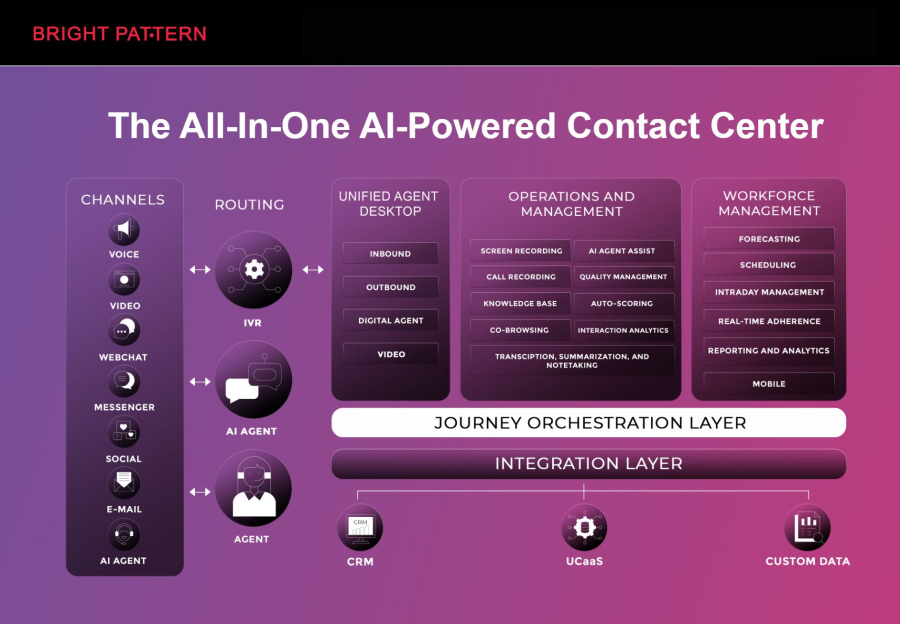
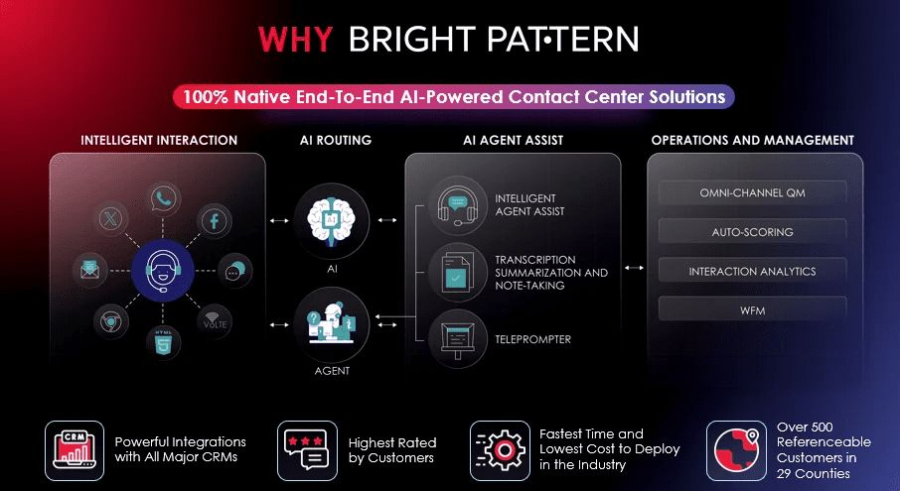
Bright Pattern offers a comprehensive AI conversational IVR platform that makes customer interactions seamless and efficient. The solution integrates with multiple communication channels including voice, chat, SMS, email, and social media, allowing contact centers to manage all interactions from a single interface.
Key features include:
- Intelligent routing powered by AI to connect customers to the right agent faster
- Real-time speech recognition for natural language interactions
- AI virtual agent support for 24/7 automated assistance
- Advanced analytics and reporting for operational insights
- Easy integration with CRM and business applications
Bright Pattern is ideal for businesses looking to enhance customer support with AI while improving agent productivity and operational efficiency.
2. Five9
Five9 provides cloud-based contact center software with AI conversational IVR capabilities. It helps automate routine calls and routes complex issues to live agents. The platform also includes speech analytics, omnichannel support, and AI-driven workforce optimization.
3. Genesys Cloud CX
Genesys Cloud CX offers AI-powered voice and digital channels. Its conversational IVR system allows customers to interact naturally with virtual agents, reducing wait times and improving resolution rates. It also provides workforce engagement tools and predictive analytics.
4. NICE inContact CXone
NICE inContact CXone combines AI automation, predictive routing, and customer journey analytics. Its AI conversational IVR enables natural language interactions, and the system can escalate calls to live agents seamlessly when needed.
5. Talkdesk
Talkdesk offers AI-driven call center solutions with an emphasis on conversational IVR, omnichannel routing, and virtual agent capabilities. The platform provides real-time insights and integrates with popular CRMs for a complete contact center experience.
6. Avaya OneCloud
Avaya OneCloud provides cloud contact center solutions with AI conversational IVR and virtual agents. The platform supports multichannel communications and offers AI analytics to optimize agent performance and improve customer satisfaction.
7. RingCentral Contact Center
RingCentral Contact Center combines AI-driven automation with human-assisted support. The conversational IVR allows natural interactions, while AI analytics helps improve service quality and agent efficiency.
8. Cisco Contact Center
Cisco’s AI-enhanced contact center solutions provide advanced IVR capabilities, virtual agents, and predictive routing. Their AI conversational IVR helps reduce call handling times and enhance the customer experience.
9. 8x8 Contact Center
8x8 delivers a cloud-based contact center platform with AI conversational IVR, real-time analytics, and workforce management. Its AI-driven virtual agents provide automated responses and support multi-channel customer engagement.
10. Microsoft Dynamics 365 Customer Service
Microsoft Dynamics 365 integrates AI conversational IVR within its customer service solutions. It uses virtual agents, predictive analytics, and omnichannel capabilities to streamline call center operations and enhance customer satisfaction.
What Is AI Conversational IVR?
AI conversational IVR(Interactive Voice Response) is a voice-driven system that uses artificial intelligence to understand and respond to callers in natural language. Instead of forcing callers through rigid, number-based menus, it lets them say things like:
- "I want to track my order"
- "I need to reset my password"
- "Can I change my flight to tomorrow morning?"
The system interprets the request, asks clarifying questions if needed, and either completes the task automatically or routes the call to the best human agent with full context.
Conversational IVR vs Traditional IVR
Traditional IVR systems rely on touch-tone inputs and fixed menu trees. AI conversational IVR adds intelligence, flexibility, and speed.
|
Aspect |
Traditional IVR |
AI Conversational IVR |
|
Interaction style |
Press 1, press 2; limited phrases |
Free-form, natural conversations |
|
Customer effort |
High; must navigate menus |
Low; just say what you need |
|
Personalization |
Minimal; generic flows |
High; uses history and context |
|
Resolution rate |
Limited self-service capabilities |
High; automates complex tasks |
|
Adaptability |
Static flows; hard to change |
Dynamic; learn and optimize |
|
Data insights |
Basic call metrics |
Rich intent and sentiment data |
How AI Conversational IVR Works
Under the hood, conversational IVR combines several AI technologies to create a smooth, natural experience.
Core Components
- Automatic Speech Recognition (ASR)converts the caller's spoken words into text.
- Natural Language Understanding (NLU)analyzes the text to detect the caller's intent and extract key details, such as dates, account numbers, or product names.
- Dialog Managementdecides what to do next: ask a clarifying question, confirm details, execute an action, or transfer to an agent.
- Text-to-Speech (TTS)generates natural-sounding responses back to the caller.
- Integrations and APIsconnect the IVR to backend systems such as CRMs, ticketing tools, billing systems, or booking platforms to actually complete tasks.
A Typical Conversational Call Flow
- Greeting– The system answers and welcomes the caller.
- Open-ended prompt– Instead of menus, it says something like,"In a few words, tell me how I can help today."
- Intent recognition– The caller describes their need; the NLU identifies the intent (for example, "pay bill" or "change reservation").
- Data capture– The IVR asks for any missing details, such as an order number or date.
- Action– It performs the task through integrated systems or queues the request for an agent.
- Confirmation– The system confirms the outcome and offers next best actions.
Business Benefits of AI Conversational IVR
Deploying AI conversational IVR can unlock measurable value across customer experience, operations, and revenue.
1. Dramatically Better Customer Experience
- Natural conversations instead of rigid menusreduce frustration and make phone interactions feel more human.
- Fewer transfers and shorter journeysmean customers reach answers faster, often on the first try.
- 24/7 availabilityensures callers can get support outside of business hours without waiting for agents.
2. Higher First-Call Resolution
- Advanced intent recognition helps route calls directly to the right flow or specialist.
- Intelligent clarification questions reduce misrouting and repeat calls.
- Access to backend data enables the IVR to complete more tasks end-to-end, without an agent.
3. Reduced Operating Costs
- Automation of routine inquiriessuch as balance checks, appointment changes, or password resets lowers the volume of calls agents must handle.
- Shorter average handling time (AHT)for calls that do reach agents, thanks to structured, pre-captured data.
- Scalable peak handlingduring busy seasons or campaigns without needing to overstaff.
4. Agent Productivity and Satisfaction
- Pre-qualified, context-rich transfersgive agents the caller's intent, history, and verified details before they even say hello.
- Less repetitive workfor agents, freeing them to focus on complex, high-value conversations.
- Improved moraleas agents spend more time solving meaningful problems and less time on simple lookups.
5. Rich Customer Insights
- Every interaction becomes structured data that reveals trending issues, common intents, and emerging needs.
- Sentiment indicators can highlight pain points in the journey before they turn into churn.
- Leaders can use these insights to refine products, policies, and customer journeys across channels.
High-Impact Use Cases for Conversational IVR
Almost any industry that handles inbound phone calls can benefit from AI conversational IVR. Here are some of the most impactful scenarios.
Banking and Financial Services
- Checking balances and recent transactions.
- Paying bills or transferring funds between accounts.
- Reporting lost or stolen cards and initiating card replacement.
- Answering common questions about fees, interest rates, and branch hours.
Telecommunications and Utilities
- Handling billing inquiries and payments.
- Guiding through troubleshooting steps for internet, TV, or phone issues.
- Scheduling technician visits or service appointments.
- Providing real-time outage information and estimated restoration times.
Retail and E-commerce
- Tracking orders and shipments.
- Initiating returns or exchanges.
- Checking stock availability at specific locations.
- Providing store hours and location details.
Travel, Hospitality, and Transportation
- Checking flight, train, or bus schedules and status.
- Changing or canceling bookings.
- Requesting early check-in or late check-out.
- Answering frequent questions about baggage, fares, and policies.
Healthcare and Public Services
- Scheduling, rescheduling, or canceling appointments.
- Providing pre-visit instructions and reminders.
- Answering high-level questions about services, locations, and opening hours.
- Routing urgent calls quickly to the right clinicians or departments.
Key Features to Look For in an AI Conversational IVR
When evaluating solutions, it helps to know which capabilities will drive the most value and long-term success.
Advanced Speech and Language Understanding
- High-accuracy ASRthat works well with different accents, speaking speeds, and background noise.
- Powerful NLU modelstrained on real-world conversational data from your industry.
- Support for multiple languages or dialects if you serve a diverse customer base.
Flexible Dialogue Design
- Tools for designing conversational flows without heavy coding.
- Context management so the system can remember information across turns in a conversation.
- Fallback and escalation paths when the system is uncertain or a human touch is needed.
Deep Integrations with Your Stack
- Connectivity to CRM, ticketing, payment, billing, and order management systems.
- Integration with your existing contact center platform and routing strategy.
- Single sign-on and role-based access so teams can securely manage and monitor the IVR.
Analytics and Optimization Tools
- Dashboards showing intents, call outcomes, containment rates, and transfer reasons.
- Conversation transcripts that make it easy to spot improvement opportunities.
- Testing and A/B experimentation features to safely roll out changes.
Implementation Roadmap: From Idea to Live IVR
Launching an AI conversational IVR does not have to be overwhelming. A structured approach helps you move quickly while managing risk.
1. Define Clear Objectives and KPIs
Start with the business outcomes you want to achieve. Common objectives include:
- Reducing average handle time (AHT).
- Improving first-call resolution (FCR).
- Raising customer satisfaction (CSAT or NPS).
- Increasing self-service containment rate.
Translate these goals into measurable KPIs and baselines so you can track impact over time.
2. Identify High-Value Call Types to Automate First
Not every call needs to be automated on day one. Focus initial efforts where you will see fast, visible wins. For example:
- High-volume, low-complexity tasks such as balance checks, order tracking, or password resets.
- Calls that follow predictable patterns and require limited judgment.
- Interactions already documented in clear scripts or agent workflows.
3. Map Existing Journeys and Design Conversational Flows
Look at how your best agents currently handle these calls. Then translate their most effective questions, explanations, and branching logic into conversational designs.
- Use open prompts to let customers speak in their own words.
- Plan for mishearings and misunderstandings; build in gentle clarifications.
- Ensure a human escape hatch is always available when needed.
4. Connect to Backend Systems
Link the IVR to internal data sources so it can actually resolve requests, not just provide information. This might include:
- Customer account databases.
- Order and shipment systems.
- Scheduling or appointment platforms.
- Authentication and verification tools.
5. Test, Iterate, and Gradually Expand
Start with a limited set of intents, measure performance, and improve before scaling up.
- Run pilot programs with a subset of customers or call queues.
- Listen to real call recordings and review transcripts to refine flows.
- Gradually add more intents, languages, and lines of business as confidence grows.
Best Practices for Designing Great Conversational Experiences
Thoughtful design can be the difference between a frustrating robot and a genuinely helpful virtual assistant.
Use Friendly, Clear Language
- Keep prompts short and conversational, like a helpful human agent would.
- Avoid jargon; use terms your customers use themselves.
- Confirm important details such as dates, times, and amounts.
Guide Without Over-Scripting
- Allow open-ended input, but provide examples to help callers know what to say.
- Break complex tasks into step-by-step questions.
- Offer options when appropriate, but avoid long, memory-heavy lists.
Design for Error Recovery
- Expect background noise, unclear speech, and mid-sentence changes of mind.
- After misunderstandings, rephrase the question or narrow the choices.
- Transfer gracefully to an agent when the system is not confident.
Make Human Handoffs Seamless
- Pass along conversation context so callers do not have to repeat themselves.
- Inform customers when a transfer is happening and why.
- Give agents tools to quickly see what the IVR already captured.
Measuring Success: Key Metrics for Conversational IVR
To sustain and expand your AI conversational IVR, you need a clear view of how it performs.
Operational Metrics
- Containment rate– The percentage of calls fully handled by the IVR without reaching an agent.
- Average handle time (AHT)– For both automated and agent-handled calls.
- Call deflection– Reduction in calls handled by human agents after automation.
Customer Experience Metrics
- CSAT or NPS after IVR interactions– Measured through short, targeted surveys.
- First-call resolution (FCR)– How often customer needs are resolved on the first interaction.
- Repeat call rate– A signal that certain flows need improvement.
Quality and Accuracy Metrics
- Intent recognition accuracy– How often the system correctly identifies what the caller wants.
- ASR error rate– A measure of speech recognition performance.
- Escalation reasons– Why calls are transferred to agents; valuable input for refinement.
Real-World Impact: Example Outcomes
Organizations that implement AI conversational IVR typically see benefits in both costs and customer experience. Common outcomes include:
- Noticeable reductions in average wait times, especially during peak hours.
- Higher self-service adoption as customers realize they can resolve tasks in seconds.
- Improved agent satisfaction scores as the mix of calls shifts toward higher-value, more engaging work.
- Better visibility into customer needs, enabling proactive changes to products and policies.
Future Trends in Conversational IVR
AI conversational IVR continues to evolve rapidly. Several trends are shaping the next generation of phone experiences.
Omnichannel Continuity
Conversations started on chat, messaging apps, or web widgets can be continued seamlessly on voice and vice versa. The system keeps context, so customers never have to start from scratch.
Proactive and Personalized Experiences
Instead of waiting for customers to explain their entire situation, conversational IVR can anticipate needs based on history and real-time data. For example, it might proactively reference a recent order, a scheduled appointment, or a known service issue in the caller's area.
Richer Emotion and Sentiment Awareness
Beyond understanding words, systems are becoming better at detecting sentiment and urgency. This enables smarter decisions about when to escalate to agents or when to alter tone and pace.
Getting Started with AI Conversational IVR
AI conversational IVR is no longer a futuristic concept; it is a practical, proven way to transform your phone channel into a modern, efficient, and customer-friendly experience.
The most successful rollouts share a few qualities:
- They start with clear business outcomes and well-chosen initial use cases.
- They focus on customer-friendly design rather than just technology features.
- They measure performance closely and iterate continuously.
By following these principles, you can turn your IVR from a source of frustration into a strategic asset that delights customers, empowers agents, and delivers measurable returns for your organization.
